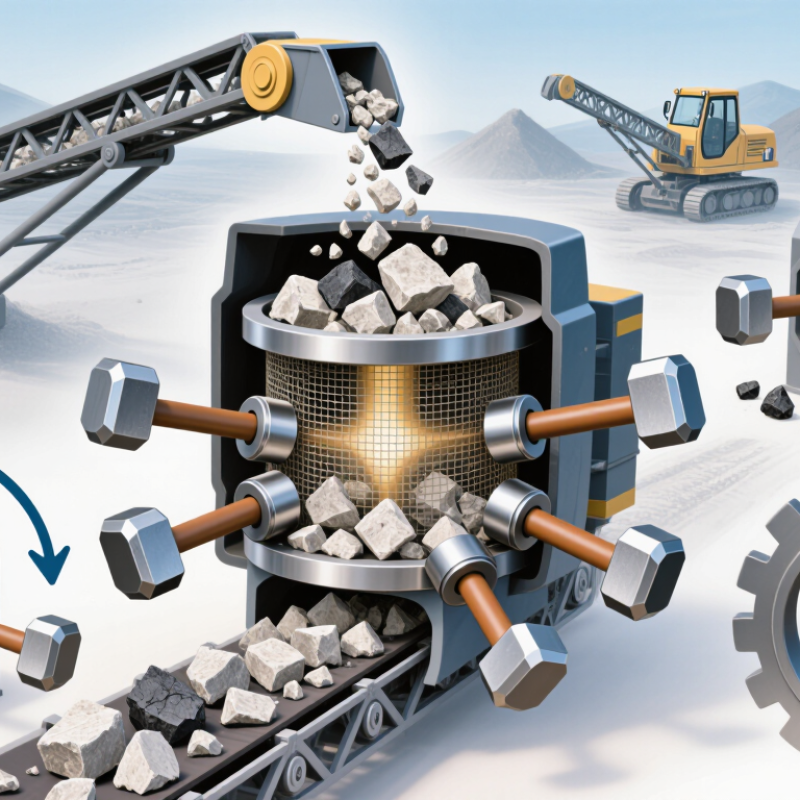
A Hammer Crusher is a size-reduction machine that uses rapidly rotating hammers to fracture feed material. The hammers strike rocks, minerals, coal, or selected industrial waste inside a crushing chamber. Impact force breaks the material against breaker plates and screens. The final product passes through openings when its size becomes small enough.
This equipment is valued for simple construction, high reduction ratios, and practical maintenance access. In a quarry, operators may hear sharp impacts as limestone enters the rotor. A properly selected screen can produce a more consistent discharge. However, performance depends on feed hardness, moisture, abrasiveness, rotor speed, and hammer design. The machine is not automatically suitable for every application. That distinction matters.
Available types include reversible Hammer Crusher models, heavy-duty hammer crushers, ring hammer crushers, and specialized vertical designs. Reversible units can use both hammer faces before replacement, reducing downtime. Heavy-duty versions suit tougher feed and demanding production conditions. Ring hammer crushers are common in coal and similar materials. Vertical models may support controlled shaping in selected operations. Each design involves trade-offs. Higher speed can improve capacity, but it may increase wear and energy use. Excessive moisture can cause clogging, especially with fine screens. A simplified description can hide these operating realities. Still, this guide provides a reliable starting point for comparing crusher types, components, applications, and selection criteria. Site testing and manufacturer data remain essential before purchase. Performance claims should always be checked against actual feed samples, required output size, and maintenance conditions.
A hammer crusher is a size-reduction machine that uses fast-moving hammers to break brittle materials. A motor rotates a rotor inside a steel crushing chamber. Material strikes the hammers, impact plates, and grate sections. It exits when its particles are small enough.
The machine suits limestone, gypsum, coal, and other relatively soft to medium-hard materials. USGS Mineral Commodity Summaries 2024 estimated U.S. crushed-stone output at about 1.5 billion metric tons in 2023. That scale explains the demand for efficient secondary and tertiary crushing equipment. However, a hammer crusher is not a universal solution. High-moisture feed can clog the grate. Very abrasive rock can also accelerate hammer wear.
A single-rotor hammer crusher offers a straightforward structure and accessible maintenance. A double-rotor design creates more impact stages for difficult reduction tasks. Reversible models can use both hammer faces, which may extend service intervals. Ring hammer crushers are common in coal-processing duties because their rotating rings create repeated impact and shearing.
In plant practice, operators should check rotor speed, discharge opening, moisture, and product grading together. A common mistake is choosing capacity before testing the material. Laboratory results may also change under continuous production conditions. That gap deserves careful review.
A hammer crusher reduces rock, coal, limestone, and other brittle materials through repeated impact. Inside the crushing chamber, a motor drives a rotor at high speed. Several hammers swing from the rotor and strike incoming material with considerable force. The material breaks against the hammers, breaker plates, and chamber walls.
As particles become smaller, they pass through a screen or grate at the bottom. The opening size helps control the final product. A larger opening produces coarser material, while a smaller opening improves size control but may reduce capacity. Operators can adjust feed rate, hammer condition, and rotor speed for changing materials. In practical use, moisture creates problems. Wet material may stick, block the screen, and increase energy consumption. The machine is effective, but it is not perfect.
Tips: Keep the feed steady and avoid oversized pieces. Inspect hammer wear, screen openings, bolts, and bearings regularly. Listen for unusual vibration or metallic noise. These signs may indicate imbalance, loose parts, or uneven wear. Record inspection results instead of relying only on memory. That small habit improves maintenance decisions.
Different designs suit different duties. Reversible models can use both hammer faces before replacement. Heavy-duty versions handle harder feed, while lighter models suit softer materials and smaller operations. Selection should consider feed hardness, moisture, desired output size, and hourly capacity. A technically suitable crusher still performs poorly when its feed conditions are ignored.
| Data Dimension | Factual Description | Typical Range or Key Characteristic | Practical Consideration |
|---|---|---|---|
| Definition | A hammer crusher is an impact-type crushing machine that reduces material size with rapidly rotating hammers mounted on a rotor. | Suitable for primary, secondary, or tertiary crushing, depending on the machine design and feed material. | It is most effective when the feed is relatively soft to medium-hard and reasonably dry. |
| Basic Working Principle | Material enters the crushing chamber, is struck by rotating hammers, and is further reduced by repeated impact against breaker plates, liners, or a grate. | Size reduction occurs mainly through impact, with additional abrasion and attrition. | The final product size is strongly influenced by rotor speed, hammer configuration, grate openings, and material properties. |
| Material Flow | After impact and collision, particles remain in the chamber until they are small enough to pass through the discharge grate or outlet. | Closed-circuit grate designs provide greater control of top product size. | Blocked or worn grates can reduce capacity and increase power consumption. |
| Common Feed Materials | Typical applications include limestone, gypsum, coal, chalk, salt, clay, shale, and other brittle or moderately abrasive materials. | Best performance is generally achieved with materials having moderate compressive strength and limited moisture. | Highly abrasive rock can cause rapid wear of hammers, liners, and screens. |
| Single-Rotor Hammer Crusher | Uses one rotor fitted with rows of swinging or fixed hammers to deliver impact energy to the feed. | Commonly used for primary or secondary crushing. | It has a relatively simple structure and is often selected for general-purpose crushing duties. |
| Double-Rotor Hammer Crusher | Uses two counter-rotating rotors, allowing material to receive impact from two hammer assemblies. | Can provide high reduction in a compact crushing chamber. | It may improve throughput and crushing uniformity, but it normally requires a more complex drive and maintenance arrangement. |
| Reversible Hammer Crusher | The rotor can operate in both directions, allowing both sides of the hammer to be used before replacement. | Designed to improve hammer utilization and simplify wear management. | Suitable where feed characteristics and product requirements permit bidirectional operation. |
| Heavy-Duty Hammer Crusher | A reinforced design with a robust rotor, housing, and wear components for larger feed sizes and higher-load applications. | Often used for primary crushing of limestone, coal, and similar bulk materials. | It requires an adequately sized feeding system and regular inspection of structural and wear parts. |
| Fine Hammer Crusher | A high-speed or finely configured hammer crusher designed to produce a smaller and more uniform discharge. | Commonly used for secondary or tertiary size reduction. | Fine crushing usually increases wear and power demand, especially with abrasive feed. |
| Hammer Mill | A hammer mill is a closely related impact machine that usually operates at higher speed and is often used for finer grinding. | Typical applications include biomass, grain, animal feed, and other relatively soft materials. | Screen openings or grate settings help determine the final particle size. |
| Typical Feed Size | Feed-size capability depends on rotor diameter, crushing chamber dimensions, hammer arrangement, and machine duty. | Industrial models may accept feed from several centimeters to several hundred millimeters. | The manufacturer’s specified maximum feed size should never be exceeded because oversized material can cause blockages or mechanical damage. |
| Typical Product Size | The discharge can range from coarse fragments to fine particles, depending on the grate, screen, rotor speed, and feed properties. | Many industrial applications produce material from a few millimeters to several tens of millimeters. | Actual product size distribution should be confirmed through testing because moisture, hardness, and particle shape affect results. |
| Reduction Ratio | Hammer crushers can achieve a relatively high reduction ratio in a single stage because impact energy is applied repeatedly inside the chamber. | A commonly cited practical range is approximately 10:1 to 20:1, although the actual ratio varies by application. | Higher reduction ratios may increase fines, wear, and energy consumption. |
| Rotor Speed | Rotor speed controls hammer velocity and therefore influences impact energy, capacity, and product fineness. | Industrial rotor speeds commonly range from several hundred to more than 1,000 revolutions per minute, depending on design. | Higher speed can improve fineness but may also increase vibration, dust, noise, and wear. |
| Capacity Factors | Throughput is affected by feed size, material density, moisture, hardness, rotor speed, grate area, and discharge conditions. | Capacity is normally specified in tonnes per hour and may range from a few tonnes per hour to several hundred tonnes per hour across different machine sizes. | Published capacity should be treated as application-specific rather than a universal performance value. |
| Moisture Sensitivity | Wet, sticky, or clay-rich feed can adhere to hammers, liners, and grates, restricting material flow. | Performance generally declines as moisture and stickiness increase. | Pre-screening, controlled feed moisture, or an alternative crusher may be necessary for wet materials. |
| Advantages | High reduction capability, compact construction, straightforward operation, and the ability to produce a relatively cubical product from suitable feed. | Often reduces the need for multiple crushing stages in soft-material applications. | Its economic benefit is greatest when the feed is not excessively abrasive or wet. |
| Limitations | High wear can occur when processing abrasive materials, while excessive moisture can cause clogging and reduced capacity. | Performance is less suitable for very hard, highly abrasive, or strongly sticky rock. | Compression crushers may be more appropriate for some hard-rock applications. |
| Wear Components | Primary wear parts include hammers, breaker plates, liners, grates, screens, and sometimes rotor protection components. | Wear rate depends on abrasiveness, impact intensity, feed gradation, and operating conditions. | Regular inspection and timely replacement help maintain product size and prevent secondary damage. |
| Power Requirement | Energy consumption depends on throughput, reduction ratio, material strength, moisture, and desired product fineness. | Drive motors range from small industrial ratings to several hundred kilowatts for large crushing systems. | Motor selection should be based on tested operating conditions rather than capacity alone. |
| Safety and Environmental Controls | Rotating parts, impact forces, dust, and noise require guarding, interlocks, lockout procedures, and suitable dust-control measures. | Enclosed housings, extraction systems, water suppression, and hearing protection may be required. | Maintenance must only be performed after the rotor has stopped and the energy sources have been isolated. |
| Best Selection Criteria | Selection should consider material type, hardness, abrasiveness, moisture, maximum feed size, required product size, capacity, and operating hours. | There is no single hammer crusher design that is optimal for every material or duty. | A material test and a complete process assessment are recommended before final equipment selection. |

Note: Performance ranges are general industrial guidelines. Actual results depend on the crusher design, feed characteristics, operating settings, and maintenance condition.
A hammer crusher reduces rock, coal, and other brittle materials through repeated impact. Its rotating rotor carries hammers that strike incoming feed against breaker plates. This design can produce a more uniform shape than some compression crushers. However, performance depends heavily on feed size, moisture, and material hardness. Wet or sticky feed may block the crushing chamber.
The main components are the rotor, hammers, crushing chamber, breaker plates, grate bars, drive system, and housing. The rotor must remain balanced because vibration can damage bearings and loosen fasteners. Hammers receive direct impact, so their edges gradually wear and change the product size. Breaker plates provide a hard surface for secondary impact. Grate bars control discharge size, while the drive system transfers power through a motor and shaft. Bearings support the rotor under demanding loads. Small cracks matter. A damaged housing or loose liner can become a serious maintenance concern. In practice, component wear is not always even, which makes inspection records valuable.
Tips: Check hammer wear before adjusting settings. Remove trapped material only after the machine is isolated and fully stopped. Listen for unusual knocking, then inspect the rotor, bearings, and fasteners. Do not assume higher speed means better output. A trial adjustment may improve capacity, but it can also increase dust, vibration, and wear. Conservative changes are usually easier to evaluate.
Hammer crushers reduce rock, limestone, coal, and recycled materials through repeated impact. Their design suits high-capacity operations, but output quality depends on feed size, moisture, and hardness. In practice, the “best” crusher is rarely universal.
The main types include heavy hammer crushers, reversible hammer crushers, ring hammer crushers, and vertical-shaft hammer crushers. Heavy hammer models handle larger feed and can produce a high percentage of finished material in one pass. Reversible designs rotate in both directions, helping distribute wear across the hammer edges. Ring hammer crushers are common for softer coal and fragile materials. Vertical-shaft versions support controlled shaping, although their product size may vary with rotor speed and screen condition. The boundary is not always clean. Some machines combine these features.
The U.S. Geological Survey’s Mineral Commodity Summaries 2024 estimated 1.5 billion metric tons of crushed stone production in the United States during 2023. That scale makes maintenance and energy use important selection factors. A larger rotor is not automatically better. I would check the abrasive index, moisture level, and required discharge size before choosing.
Tips: Use a reversible model when wear costs are high. Select a ring hammer design for softer feed. Inspect grates daily when material contains clay. Keep a test sample, because laboratory assumptions can miss real quarry behavior.
Choosing the right hammer crusher starts with the material, not the machine’s advertised capacity. Test the feed for hardness, moisture, abrasiveness, and maximum lump size. Limestone may crush easily, while wet clay can clog screens and reduce output. That difference matters.
Capacity should match the real feed rate, not an ideal laboratory figure. Leave practical allowance for moisture changes, uneven feeding, and occasional oversized stones. I have seen poorly matched equipment lose efficiency because operators ignored these details. It is an easy mistake.
Review rotor speed, hammer material, screen access, and replacement time with a qualified engineer. Ask for test data using your own feedstock when possible. Wear costs can quietly exceed the purchase price. Also inspect guarding, emergency stops, dust control, and maintenance access before installation. A crusher that is powerful but difficult to service may create avoidable downtime. My own preference is to compare measured operating data rather than trust a single specification sheet. Some assumptions still need checking.